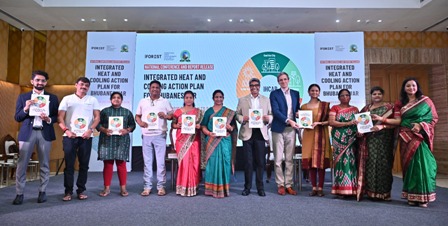
Bhubaneswar (Odisha Tazanews) :- The environment think tank International Forum for Environment, Sustainability & Technology (iFOREST) and the Bhubaneswar Municipal Corporation (BMC) today released the Integrated Heat and Cooling Action Plan (IHCAP) for Bhubaneswar—India’s first city-level framework to address rising heat stress and cooling demand in an integrated manner.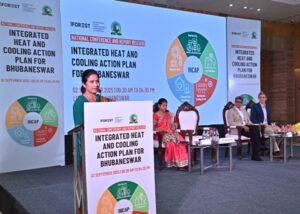 Developed by iFOREST in collaboration with the Singapore-ETH Centre (SEC), the IHCAP for Bhubaneswar provides a comprehensive roadmap to tackle the growing challenge of increasing temperatures and humidity, the Urban Heat Island (UHI) effect, and rapidly rising demand for cooling.
The report was released by Smt. Sulochana Das, Mayor, Bhubaneswar Municipal Corporation, Dr. Chandra Bhushan, CEO, iFOREST and Mr Ander Zozaya Project Manager, Cooling Singapore, Singapore-ETH Centre (SEC). Speaking at the launch, Dr. Chandra Bhushan, CEO of iFOREST, said:
“Heat stress is now among the gravest challenges for India’s cities. With IHCAP, Bhubaneswar is demonstrating how cities can break the vicious cycle of rising temperatures, growing cooling demand, and increasing energy consumption and emissions. This should become a blueprint for other Indian cities, bridging the gap between mitigation and adaptation, and aligning local action with state and national climate strategies.”
Smt. Sulochana Das, Mayor of Bhubaneswar, added:
“Bhubaneswar has always embraced forward-looking urban solutions. The IHCAP reflects our vision of a climate-smart city that protects vulnerable citizens, ensures that every household, workplace, and public space in Bhubaneswar is prepared for the realities of a warming world, and promotes sustainable growth.”

Mr Ander Zozaya Project Manager, Cooling Singapore, Singapore-ETH Centre (SEC), spoke about the urban climate simulation tools being developed at SEC:
“Our goal at Singapore ETH center is to develop tools that equip policymakers and urban planners with the information to make robust and scientifically consistent decisions. Our analysis has revealed an Urban Heat Island effect of 7°C in Singapore compared to the surrounding area. With the digital urban climate twin model that we have developed, urban planners can trial different scenarios and intervention strategies to come up with the best course of action to mitigate urban heat in the given city.”
iFOREST undertook year-long research to develop the IHCAP. Some key findings of the research are:
-
Long-term climate trends indicate a steady rise in temperature and humidity levels in Bhuwaneshwar. Summers are not only hotter but also more humid, significantly heightening the risk of heat stroke.
-
Heat stress in Bhubaneswar now extends until October. If IMD’s experimental “Feels Like” temperature threshold is applied, more than 230 days in 2024 would have been declared as Orange or Yellow alert days.
-
The Urban Heat Island effect is intensifying due to large-scale concretisation. Between 2018 and 2024, built-up areas increased by 23%, while vegetation declined by 10% and water bodies by a drastic 75%.
-
The temperature difference between Bhubaneswar and surrounding rural areas currently ranges between 2.0–5.0°C.
-
Around 30% of workers—especially in construction, transport, street vending, and gig work—lose 20–30% productivity and wages due to heat stress. Citywide, annual income loss has already reached 6%.
-
Between 2021 and 2023, household ownership of air conditioners rose from 6% to 15% (a 73% annual growth rate). ACs now account for one-third of the city’s electricity consumption and nearly two-thirds during summer.
-
Climate projections show that by 2050, a “normal hot day” in Bhubaneswar will feel similar to today’s extreme heat days.
-
Under a Business-as-Usual scenario, electricity consumption from cooling is projected to increase 6 times by 2050.
Using advanced modelling techniques, the IHCAP provides actionable recommendations for Bhubaneswar along five key pillars:
-
Cool the City: Expand urban greening in all wards to meet WHO’s benchmark of 9 m² per person; implement citywide cool roof programmes; restore water bodies; promote green roads, pavements, and undertake traffic decongestion.
-
Cool Buildings: Revise and implement Odisha Energy Conservation Building Codes for all commercial and institutional buildings over 500 m²; adopt Eco-Niwas Samhita 2024 for residential plots above 225 m².
-
Sustainable Cooling for All: Roll out white roof programmes in slums; provide incentives for super-efficient fans and 5-star ACs; pilot district cooling systems in commercial and institutional zones.
-
Enhance Heat Resilience: Strengthen electricity, water, and health infrastructure; establish cooling shelters and shaded, ventilated bus stops.
-
Adapt to Heat: Revise heat thresholds to include humidity and night-time conditions; introduce spatial heat-risk mapping; pilot parametric insurance for vulnerable workers.
If effectively implemented, the IHCAP could reduce surface temperatures by 0.5–9.4°C, depending on the intervention, and cut the city’s energy consumption for cooling by 44–67%.
Following the release, national and state-level experts, policymakers, and practitioners participated in a high-level consultation to discuss the institutional, policy, and financial reforms needed to mainstream IHCAP. Discussions emphasised the need to integrate heat-risk reduction into urban master planning, enforce energy-efficient building codes, strengthen electricity policy during heat seasons, and revise national guidelines for Heat Action Plans to incorporate sustainable cooling.